
Most powerful way to doFigma Variables
VV turns Figma variables into a living graph. Designers build and debug variables visually. Developers ship the exact same values via a tiny build-time resolver.
See your variable system in 2D.
Explore collections, modes, and aliases as a living graph. Trace dependencies, validate values, and debug visually before you export for build.
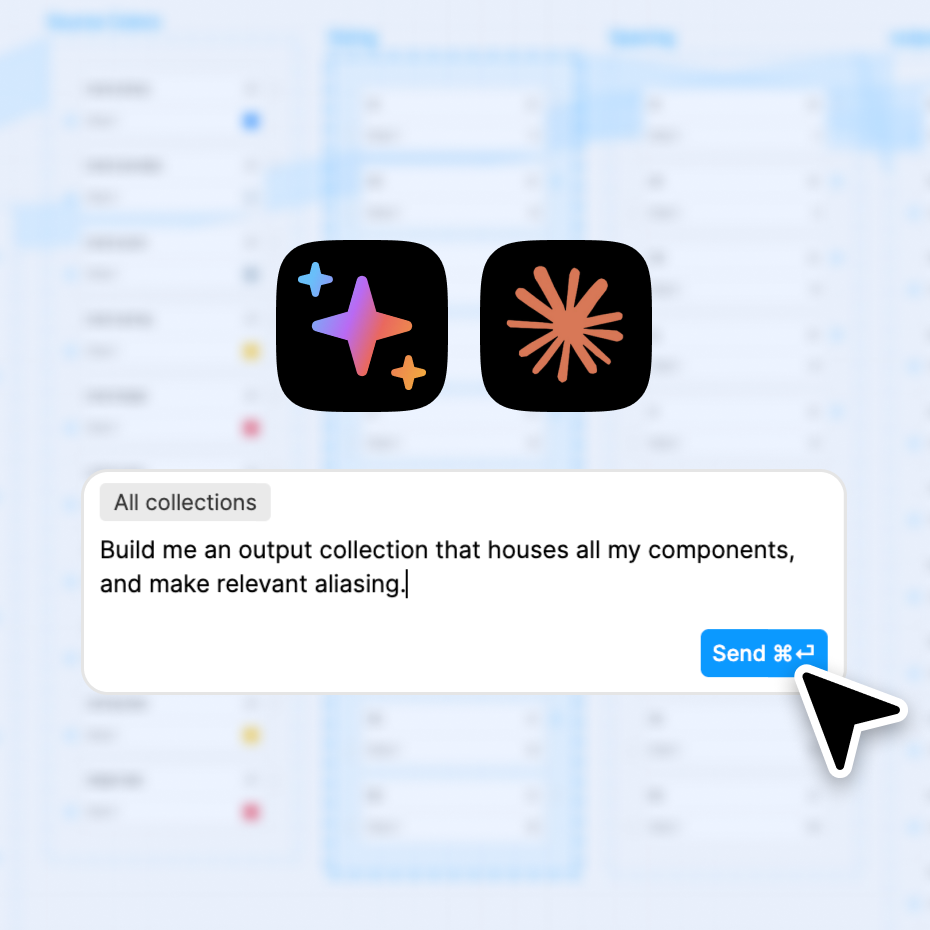
AI that designs, binds, and refactors variables.
Ask for what you need: discover relationships, create collections and modes, bind attributes, rename at scale, or generate color scales to match a reference. Results are explicit and reviewable.
Design‑to‑dev in one move
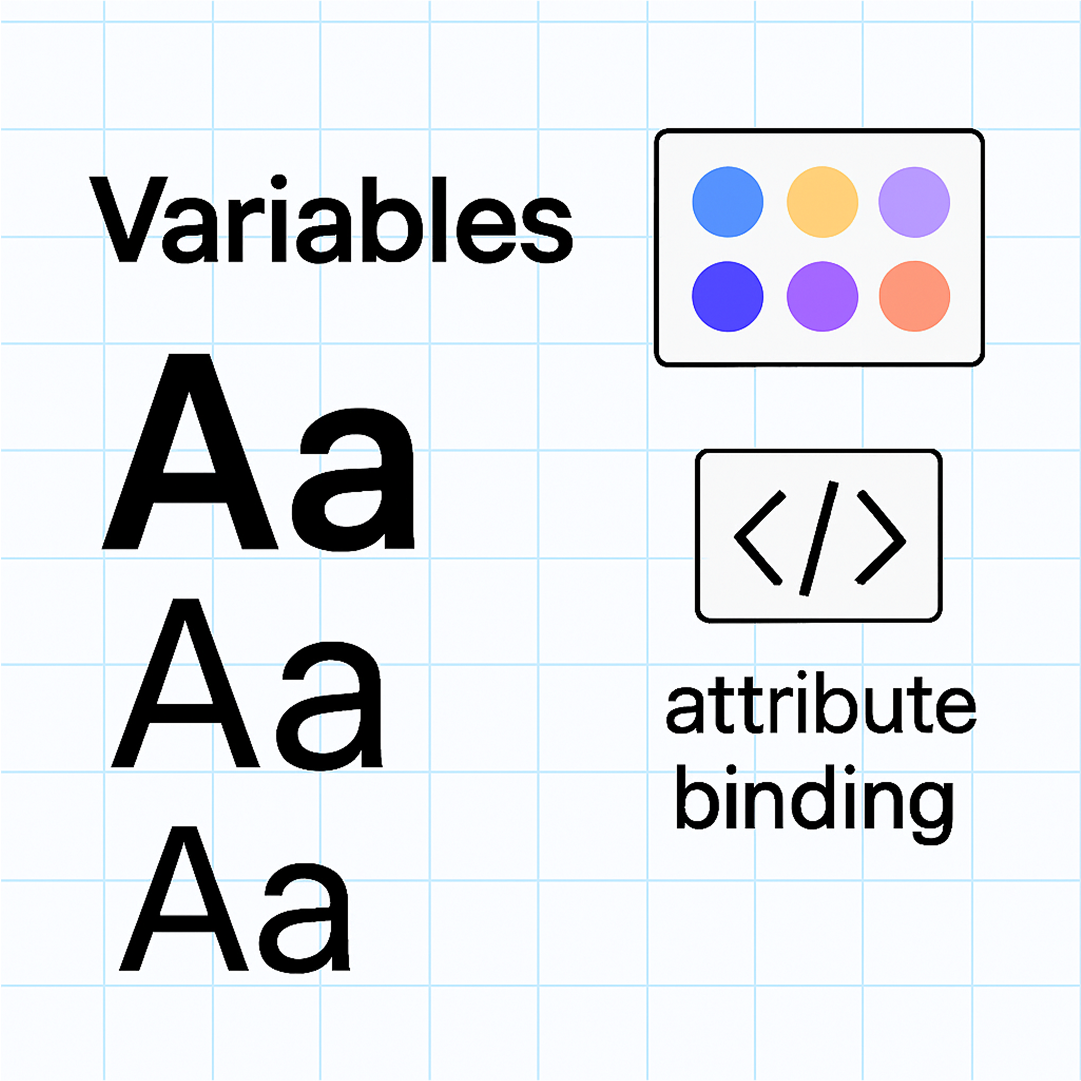
Export the graph in VV as JSON. Use the same variable binding and your build outputs will now match your Figma file — deterministically.
// useTokens.js
import { getVariableByName } from '../design-tokens/resolver.js'

// resolve exactly what you render
const text = getVariableByName('text/regular', modes)
const bg = getVariableByName('card/bg-fill', modes)
const accent = getVariableByName('large number/fill', modes)

// use text, bg, accent directly in your UI
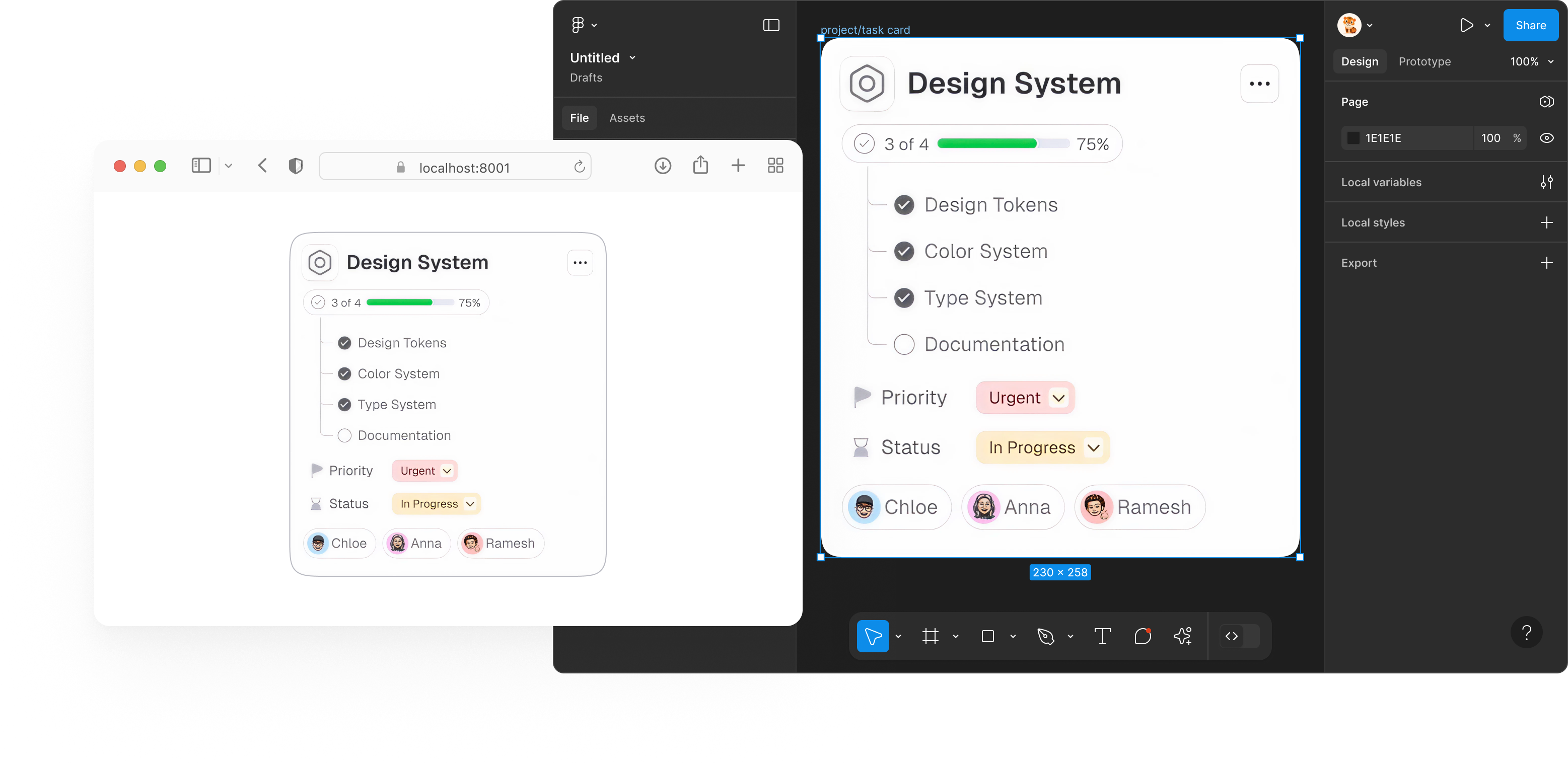
Zero drift. Deterministic by design.
The values developers get are the same values designers see, by definition.
No translation layer, no divergence, no surprises.
Pricing
Start free. Upgrade when you need AI assistance, cross-library reference, team seats – or talk to us about enterprise licensing for organization-wide use.
Individual plans are perfect for designers exploring better variable systems. Organization-wide or platform use requires an enterprise agreement. Enterprise licensing includes org-wide design-to-dev pipelines, multi-brand AI-ready foundations, design system audits and architecture reviews, and clear IP boundaries and branding – VV remains an independent product.
FAQ
Can our whole company use VV as a core part of our design system or AI platform?
Yes – but organization-wide or strategic use requires an enterprise agreement with us. Individual plugin subscriptions are intended for personal or small-team use. If you plan to use VV as a central engine for your design system, AI workflows, or internal platform, please contact us to set up an enterprise licence.
Can we present VV-powered flows as our own internal tooling?
You’re welcome to integrate VV into your internal workflows and platforms, but Variable Visualiser remains an independent product and brand. You may not remove VV branding, rebrand it as your own product, or imply that you own the underlying technology without our written permission. For white-label or partnership discussions, please get in touch.
Can we rebuild VV’s concepts internally for our own platform?
VV’s resolver, UI, and brand are our intellectual property. You’re free to learn from modern variable practices, but copying or recreating VV’s product, UI, or resolver logic as an internal clone is not permitted. If you’re interested in a deeper partnership (audits, architecture, custom integrations), we’re happy to discuss that under an enterprise agreement.
Why do you say “variables” instead of “tokens”?
VV works with Figma variables as they exist in your file: names, collections, modes, and aliases. We avoid the overloaded word “token” so there’s no confusion with API keys or usage counts — and no extra translation layer. What you design is what you ship.
How does VV keep design and build aligned?
The resolver evaluates the same relationships as Figma at build time. When you export the VV graph once, your app resolves variables deterministically for any mode. No manual mapping, no drift.
Can VV handle multiple libraries and remote collections?
Yes. Both the visualizer and the resolver understand references across libraries and remote collections, so previews and build outputs stay consistent.
Where do I store the export in my repo?
Keep it in a predictable path like src/vv/variables.json. Import it at build time and emit stable artifacts (CSS/TS) for your runtime to use.
Do I need to paste the JSON export into an AI?
No. As long as your variable bindings are set correctly, you’re done. Only the resolver reads the JSON at build time. AI helps write bindings in Figma — it never needs the JSON.
Variable Visualiser — Terms & Conditions
Last updated: December 3, 2025
These Terms & Conditions (the “Terms”) govern your access to and use of Variable Visualiser, including the Figma plugin, website, AI-assisted features, credit system, and any related services (collectively, the “Services”).
By installing or using the Services, you agree to be bound by these Terms. If you do not agree to these Terms, you may not use the Services.
Important: This document is provided for informational purposes only and does not constitute legal advice. You should review and customize it with your own legal counsel before relying on it.
1. Definitions
In these Terms:
- “We”, “us”, “our” means the creators and operators of Variable Visualiser, currently Marcin Śpiewak and [Full legal name of Mr. Biscuit], operating as an unincorporated partnership under the name “Variable Visualiser”.
- “You”, “your” means the individual user or the organization on whose behalf the Services are used.
- “Plugin” means the Variable Visualiser Figma and Dev Mode plugin, as described in the Figma Community listing.
- “Website” means our marketing site and any related web properties where the Services are promoted or managed.
- “AI Features” means any functionality that uses third-party AI models (such as Claude from Anthropic) via our secure API server.
- “Credits” means the usage-based units associated with your account that meter access to AI Features and other paid functionality.
- “Subscription” means a paid plan with recurring or prepaid access to Credits and premium features.
Variable Visualiser is currently operated by its creators as an independent project and is not yet incorporated as a separate legal entity.
2. Scope of Services
The Services are designed to:
- Visualize and manage Figma variables, collections, and modes through a node-based interface.
- Provide build-time resolvers and exports so that application code can deterministically resolve the same values as seen in Figma.
- Offer AI-assisted tools that help you design, refactor, and bind variables (for example, generating color scales or proposing variable bindings).
- Provide a credit-based usage model and subscription options as described on the Pricing page.
We may add, change, or remove features from time to time. Material changes will be reflected in updated documentation or release notes.
The Plugin depends on Figma’s platform and APIs. We do not control Figma’s services and are not responsible for any interruptions, changes, or limitations introduced by Figma. Figma is a third-party service provider and not a party to these Terms. Variable Visualiser is not affiliated with, endorsed by, or sponsored by Figma, Inc.
3. Organizational and Enterprise Use
Use of the Services at organization-wide scale, or as part of any core internal platform, design system, or AI stack, requires a separate written enterprise agreement with us.
Examples of enterprise or strategic use include (without limitation):
- Using the Services as a central variable engine for multiple products or teams;
- Demonstrating the Services to executive or board-level stakeholders as part of your internal platform;
- Integrating the Services into an internal tool that is rolled out across your organization.
Individual Subscriptions purchased through the standard pricing page do not grant rights for such enterprise or organization-wide use.
4. Eligibility and Accounts
- You must be at least 18 years old, or the age of majority in your jurisdiction, to use the Services.
- If you are using the Services on behalf of a company or organization, you represent that you have authority to bind that entity to these Terms, and “you” will refer to that entity.
- Some parts of the Services may associate usage with a Figma account, workspace, team, or other identifier. You are responsible for maintaining the security of your credentials and any API keys or secrets you configure.
- Where the Services are purchased by an organization, that organization is deemed the account owner and may control access to and information associated with the account.
5. Subscriptions, Credits, and Billing
Paid access to certain features (including AI Features and higher usage tiers) is provided on a subscription and/or credit basis, as described on the Pricing page and related documentation.
- Plans and pricing. The current plans, features, and prices are listed on the Website. We may change pricing or plan structure prospectively. Any changes will not retroactively affect amounts already paid for the current billing period.
- Billing and renewals. When you purchase a Subscription, you authorize us (or our payment processor) to charge you the applicable fees, taxes, and any other charges on a recurring basis until you cancel. Unless otherwise stated, Subscriptions renew automatically at the end of each billing period.
- Payment processing. Payments for Subscriptions and Credits are processed by our third-party provider Lemon Squeezy or such other payment processor as we may use from time to time. Your purchase may also be subject to Lemon Squeezy’s own terms and policies, which are a separate agreement between you and that provider. We are not responsible for the acts or omissions of such third-party payment providers.
- Credits. Usage of certain features consumes Credits. Credits may (a) be granted as part of a plan (e.g., a monthly allowance), (b) be topped up through separate purchases, and (c) be reset according to our monthly-reset rules, which may include preserving higher balances and not resetting more than once per period. Credits have no cash value, are not refundable, and are non-transferable except as we explicitly permit in writing.
- Monthly credit resets. For eligible paid users, we may provide recurring monthly resets of Credits according to the logic described in our technical documentation (for example, checking subscription status and topping up balances that fall below a target threshold). The exact thresholds, timing, and eligibility criteria may change over time.
- No refunds except as required by law. Fees are generally non-refundable, including for partial billing periods, unused Credits, or downgraded plans, except where required by applicable law or explicitly stated otherwise in the applicable offer or in writing.
- Taxes. Fees are exclusive of any applicable taxes, levies, or duties. You are responsible for paying such amounts where required.
- We may impose reasonable technical limits on usage (such as rate limits or credit caps) to ensure stability and fair use for all users.
6. Use of AI Features
Some parts of the Services call third-party AI models (such as Anthropic’s Claude) through our secure API server. When you use these features, you authorize us to send relevant prompts, context, and variable metadata to our AI infrastructure and third-party AI providers in order to process your request.
- You are responsible for the content of any prompts or inputs you provide, including ensuring that you have rights to use any code, designs, or data you submit.
- AI output is generated automatically and may be inaccurate, incomplete, biased, or otherwise unsuitable for your use case. You must review and validate all AI output before relying on it in production, design systems, or other workflows.
- You agree not to use the AI Features to process sensitive personal data or regulated information unless you have appropriate legal and contractual safeguards in place and it is expressly permitted by the relevant provider terms.
- AI Features are subject to additional usage restrictions imposed by our AI providers, and you agree to comply with those restrictions.
- We may retain and review AI interactions (prompts and outputs) for the purposes of abuse detection, debugging, and improving the Services, in accordance with our Privacy Notice and applicable law.
- You are solely responsible for reviewing and testing any exports, resolvers, or AI-assisted outputs before using them in production systems.
7. Data, Privacy, and Security
Our Services operate primarily on metadata about Figma variables, collections, and modes, along with usage and account information necessary to operate the credit system and Subscriptions.
- We may collect information such as Figma user identifiers, team or workspace identifiers, variable names and relationships, mode structures, usage metrics, and technical logs (for example, API request/response metadata), plus information necessary for account management, billing, and support.
- We use this information to provide and improve the Services, manage access and billing, detect abuse, and maintain security and reliability.
- Where we use third-party providers (for example, hosting providers, payments, or AI infrastructure), we share only the information reasonably necessary for them to perform their functions.
- You are responsible for ensuring that your use of the Services, and any data you process through them, complies with applicable privacy and data protection laws, as well as any contractual obligations you have with your own customers or stakeholders.
We may use aggregated and anonymized usage data and telemetry to analyze performance, improve the Services, and develop new features. Such data will not identify you or your end users.
We may publish a separate Privacy Notice describing our data practices in more detail. In the event of any conflict between that notice and these Terms, these Terms will govern the contractual relationship, while the Privacy Notice will govern how we handle personal data. Where we process personal data on your behalf, we do so as a processor in accordance with applicable data protection laws. We may make a separate Data Processing Agreement (DPA) available for this purpose.
8. Acceptable Use
You agree not to misuse the Services. In particular, you must not:
- Reverse engineer, decompile, or attempt to derive the source code of any part of the Services except to the extent permitted by law.
- Bypass or attempt to circumvent any security or access-control mechanisms.
- Use the Services to infringe the intellectual property or other rights of any third party.
- Use the Services to generate or distribute harmful, unlawful, or abusive content, including but not limited to malware, harassment, hate speech, or content that violates applicable laws or regulations.
- Access the Services in a way that is intended to or does unduly burden or disrupt our infrastructure (for example, through automated scraping or high-volume programmatic use that exceeds reasonable usage for the selected plan).
- Use Credits or AI Features in ways that violate the terms of our underlying AI or infrastructure providers.
9. Intellectual Property
- We (and our licensors, where applicable) retain all rights, title, and interest in and to the Services, including all software, documentation, designs, logos, and other content we provide.
- Subject to your compliance with these Terms and payment of any applicable fees, we grant you a limited, non-exclusive, non-transferable, revocable license to use the Services for your internal business or personal purposes.
- You retain all rights to your own designs, variables, code, and other content you create in Figma or your own environments. We do not claim ownership over such content.
- To the extent AI output is subject to intellectual property rights, you will generally own the rights in the output as between you and us, subject to the rights of any third-party providers and applicable law. You are responsible for ensuring that your use of the output complies with those third-party terms.
No Rebranding or White-Label Use
You may not remove, obscure, or alter our branding, trademarks, or attribution in the Services, or present the Services (or any substantial part of them) as your own internal product or platform, without our prior written consent.
Any white-label, OEM, or co-branded use of the Services must be governed by a separate written agreement.
10. Third-Party Services
The Services may depend on or integrate with third-party platforms and services, including but not limited to:
- Figma (for plugin hosting, Dev Mode, and design data access)
- AI model providers (for example, Anthropic)
- Hosting and infrastructure providers (for example, Vercel, Cloudflare Workers, and D1 databases)
- Payment and billing processors (for example, Lemon Squeezy)
- Developer tools and version control platforms (for example, GitHub)
Your use of any third-party services is subject to their own terms and policies. We are not responsible for the acts or omissions of such third parties.
11. Beta Features and Experimental Functionality
From time to time we may make beta or experimental features available, including early AI capabilities, new visualizations, or integrations. These features may be labeled “beta”, “experimental”, “preview”, or similar.
- Beta features are provided “as is” and may be changed, suspended, or discontinued at any time without notice.
- Performance, reliability, and availability of beta features may differ from generally available features and may not be covered by any uptime or support commitments.
12. Disclaimer of Warranties
To the maximum extent permitted by law, the Services are provided on an “AS IS” and “AS AVAILABLE” basis, without warranties of any kind, whether express, implied, or statutory.
We specifically disclaim any implied warranties of merchantability, fitness for a particular purpose, non-infringement, and any warranties arising out of course of dealing or usage of trade.
We do not warrant that the Services will be uninterrupted, error-free, secure, or free of harmful components, or that they will meet your requirements or expectations.
You understand that the Services are provided by a small independent team and do not come with any guaranteed service levels, response times, or support commitments unless we explicitly agree otherwise in writing.
13. Limitation of Liability
To the maximum extent permitted by law, in no event will we be liable for any indirect, incidental, special, consequential, or punitive damages, or any loss of profits, revenues, data, or business opportunities, arising out of or related to your use of (or inability to use) the Services, whether based on contract, tort, or any other legal theory, even if we have been advised of the possibility of such damages.
To the maximum extent permitted by law, our total aggregate liability for all claims arising out of or relating to the Services or these Terms will not exceed the greater of (a) the amounts you actually paid us for the Services in the twelve (12) months preceding the event giving rise to the claim, or (b) one hundred (100) U.S. dollars (or the equivalent in your local currency).
Some jurisdictions do not allow certain limitations or exclusions of liability, so some of the above limitations may not apply to you. In such cases, our liability will be limited to the maximum extent permitted by applicable law.
14. Indemnification
You agree to indemnify, defend, and hold harmless us and our affiliates, officers, directors, employees, and agents from and against any claims, liabilities, damages, losses, and expenses (including reasonable attorneys’ fees) arising out of or related to (a) your use of the Services; (b) your violation of these Terms; or (c) your violation of any rights of a third party, including intellectual property or privacy rights.
15. Suspension and Termination
- We may suspend or terminate your access to the Services (or any part of them) at any time, with or without notice, if we reasonably believe you have violated these Terms, pose a security or legal risk, or are otherwise using the Services in a way that could harm us, other users, or third parties.
- You may stop using the Services at any time. If you wish to terminate a Subscription, you may cancel through the relevant billing interface or by contacting us as described on the Website. Cancellation will generally be effective at the end of the current billing period.
- Upon termination, your right to use the Services will cease, but provisions of these Terms that by their nature should survive (including ownership, payment obligations, disclaimers, limitations of liability, indemnity, and governing law) will continue to apply.
Right to Restrict Organizational Use
We may refuse, suspend, or terminate access to the Services for any organization where we reasonably believe that such use:
- Misrepresents the origin or ownership of the Services;
- Creates a risk of confusion regarding our product or brand; or
- Conflicts with our business interests or existing agreements.
In such cases, we may also refund recent payments at our discretion and require that you cease any enterprise or organization-wide use of the Services.
16. Changes to These Terms
We may update these Terms from time to time. When we do, we will revise the “Last updated” date at the top of this page and may provide additional notice (for example, in-product notifications or emails) where appropriate.
Your continued use of the Services after the effective date of any changes constitutes your acceptance of the updated Terms. If you do not agree to the updated Terms, you must stop using the Services.
17. Governing Law and Dispute Resolution
These Terms, and any dispute arising out of or relating to them or the Services, will be governed by and construed in accordance with the laws of Germany, without regard to its conflict of law principles.
You and we agree to submit to the exclusive jurisdiction of the courts located in Berlin, Germany, to resolve any dispute arising out of or relating to these Terms or the Services, except where applicable law provides you with a right to bring claims in other forums.
If you are a consumer residing in the European Union or the United Kingdom, you may also benefit from mandatory provisions of the law of your country of residence, and nothing in these Terms limits those rights.
18. Miscellaneous
- Entire agreement. These Terms constitute the entire agreement between you and us regarding the Services and supersede any prior or contemporaneous agreements on the same subject matter.
- Severability. If any provision of these Terms is held to be invalid or unenforceable, that provision will be enforced to the maximum extent permissible, and the remaining provisions will remain in full force and effect.
- No waiver. Our failure to enforce any right or provision of these Terms will not be considered a waiver of such right or provision.
- Assignment. You may not assign or transfer these Terms or any rights or obligations under them without our prior written consent. We may assign these Terms without restriction.
- Feedback. If you provide feedback, ideas, or suggestions regarding the Services (“Feedback”), you grant us a perpetual, irrevocable, worldwide, royalty-free license to use and incorporate the Feedback into our products and services without any obligation or compensation to you.
19. Contact
If you have any questions about these Terms or the Services, please contact us at team@variablevisualizer.com or via the contact details provided on the Website or in our official plugin listings.
Variable Visualiser — Privacy Policy
Last updated: December 3, 2025
This Privacy Policy describes how Variable Visualiser (“we”, “us”, or “our”) collects, uses, and protects information when you use our Figma plugin, website, and related services (collectively, the “Services”).
We are committed to protecting your privacy and ensuring transparency about our data practices. This policy explains what information we collect, why we collect it, and how we use it.
1. Our Privacy Philosophy
Variable Visualiser is built on a fundamental principle: your data belongs to you. The plugin operates as a visual interface layer that works directly with Figma’s native variable system. We do not store, copy, or retain your design data, variable structures, or variable values on our servers.
All variable data—including names, collections, modes, values, and aliases—remains stored exclusively within your Figma files and is managed through Figma’s platform. When you use the plugin to create, modify, or delete variables, these changes occur directly in Figma through Figma’s official APIs. The plugin reads variable data in real-time from Figma and does not maintain any local copies or caches of your design data.
2. Information We Collect
We collect only the minimal information necessary to provide and improve our Services:
2.1 Account and Access Information
- Figma User ID: A permanent, unique identifier provided by Figma that we use to manage access, subscriptions, and credits. This ID persists even if you change your Figma username.
- Figma Username: Your current Figma display name, used for account management and support purposes. This is updated automatically when you change your username in Figma.
- Email Address: Collected only when you purchase a subscription or credits through our payment processor (Lemon Squeezy), used for billing, receipts, and account-related communications.
2.2 Usage and Transaction Data
- Credits Balance: Your current credit balance and transaction history for AI feature usage.
- Subscription Information: Your subscription type, status, expiration date, and license key (if applicable).
- Transaction Logs: Records of credit purchases, usage, and subscription events for billing and support purposes.
- API Request Metadata: Technical logs including request timestamps, response codes, and error information for debugging and service improvement. These logs do not include the content of your variable data or design files.
2.3 AI Feature Usage
When you use AI-assisted features (such as generating color scales or proposing variable bindings), we send relevant prompts and variable metadata to our secure API server, which forwards requests to third-party AI providers (currently Anthropic’s Claude API). This includes:
- Your prompts and instructions
- Variable names, types, and relationships (but not actual values or design content)
- Collection and mode structures
Important: We do not send actual variable values, color data, or design file contents to AI providers unless you explicitly include such information in your prompts. Variable metadata (names, types, relationships) is sent to help the AI understand context and generate appropriate suggestions.
2.4 Website Usage
- Analytics: We may use standard web analytics tools to understand how visitors use our website. This may include aggregated, anonymized data about page views, navigation patterns, and general usage trends.
- Cookies and Local Storage: We use browser storage to remember your theme preference (light/dark mode) and to maintain session state. This information is stored locally on your device and is not transmitted to our servers.
3. What We Do Not Collect
We explicitly do not collect, store, or transmit:
- Your Figma design files or file contents
- Variable values or resolved color/data values
- Layer information, component structures, or design elements
- Images, assets, or any visual content from your Figma files
- Your Figma workspace or team membership details (beyond what is necessary for access control)
- Any information about other users in your Figma workspace
The plugin operates entirely through Figma’s official APIs and reads data only when you actively use the plugin. We do not perform background data collection, scanning, or monitoring of your Figma files.
4. How We Use Information
We use the information we collect solely for the following purposes:
- Service Delivery: To provide access to the plugin, manage subscriptions, track credits, and enable AI features.
- Access Control: To verify your identity, manage beta access, and enforce subscription limits.
- Billing and Payments: To process payments, manage subscriptions, and provide receipts through our payment processor.
- Support and Communication: To respond to your inquiries, provide technical support, and send important service-related notifications.
- Service Improvement: To analyze usage patterns (in aggregated, anonymized form), debug issues, and improve the reliability and performance of our Services.
- Abuse Prevention: To detect and prevent fraudulent activity, abuse, or violations of our Terms of Service.
5. Data Sharing and Third-Party Services
We share information only with trusted third-party service providers that help us operate our Services:
5.1 Payment Processing
Payments are processed by Lemon Squeezy, a third-party payment provider. When you make a purchase, Lemon Squeezy collects payment information (credit card details, billing address) directly. We receive only transaction confirmations and your email address for receipt delivery. Lemon Squeezy’s use of your information is governed by their own privacy policy.
5.2 AI Services
AI features are powered by Anthropic’s Claude API. When you use AI features, we send your prompts and relevant variable metadata to Anthropic for processing. Anthropic’s use of this information is governed by their privacy policy and terms of service. We do not share your Figma user ID or other account information with AI providers.
5.3 Hosting and Infrastructure
Our Services are hosted on Vercel and Cloudflare infrastructure. These providers have access to technical logs and metadata necessary for service operation, but they do not have access to your account information or variable data.
5.4 No Sale of Data
We do not sell, rent, or trade your personal information to third parties for marketing or advertising purposes. We do not share your information except as described in this Privacy Policy or as required by law.
6. Data Storage and Security
Account and transaction data is stored in Cloudflare D1 databases, which are encrypted at rest and accessed only through secure API endpoints. We implement industry-standard security measures, including:
- Encryption of data in transit using HTTPS/TLS
- Secure authentication and access controls
- Regular security audits and monitoring
- Minimal data retention practices
However, no method of transmission over the internet or electronic storage is 100% secure. While we strive to protect your information, we cannot guarantee absolute security.
7. Data Retention
We retain your account information and transaction records for as long as your account is active or as needed to provide Services, comply with legal obligations, resolve disputes, and enforce our agreements. If you delete your account or request deletion, we will delete or anonymize your personal information within a reasonable timeframe, except where we are required to retain it for legal or legitimate business purposes.
Transaction logs and audit trails may be retained for longer periods to comply with accounting, tax, and legal requirements.
8. Your Rights and Choices
Depending on your location, you may have certain rights regarding your personal information:
- Access: You can request access to the personal information we hold about you.
- Correction: You can request correction of inaccurate or incomplete information.
- Deletion: You can request deletion of your personal information, subject to legal and contractual obligations.
- Portability: You can request a copy of your data in a structured, machine-readable format.
- Objection: You can object to certain processing activities, such as direct marketing.
- Withdrawal of Consent: Where processing is based on consent, you can withdraw consent at any time.
To exercise these rights, please contact us at team@variablevisualizer.com. We will respond to your request within a reasonable timeframe and in accordance with applicable law.
9. International Data Transfers
Our Services are operated from servers located in the United States and other countries. If you are located outside the United States, please be aware that your information may be transferred to, stored, and processed in the United States and other jurisdictions where our service providers operate.
By using our Services, you consent to the transfer of your information to these jurisdictions. We take appropriate measures to ensure that your information receives an adequate level of protection in accordance with applicable data protection laws.
10. Children’s Privacy
Our Services are not intended for individuals under the age of 18. We do not knowingly collect personal information from children. If you believe we have inadvertently collected information from a child, please contact us immediately so we can delete it.
11. Changes to This Privacy Policy
We may update this Privacy Policy from time to time to reflect changes in our practices, technology, legal requirements, or other factors. When we make changes, we will update the “Last updated” date at the top of this page and may provide additional notice through the Services or via email for material changes.
Your continued use of the Services after the effective date of any changes constitutes your acceptance of the updated Privacy Policy. If you do not agree to the updated Privacy Policy, you must stop using the Services.
12. Contact Us
If you have any questions, concerns, or requests regarding this Privacy Policy or our data practices, please contact us at:
Email: team@variablevisualizer.com
Website: variablevisualiser.com
For users in the European Union, you also have the right to lodge a complaint with your local data protection authority if you believe we have not addressed your concerns adequately.